

A Love Letter to the Humble Cassette
The young kids are discovering the iPod. This older kid is rediscovering cassettes.

Recently, I’ve been playing cassettes a lot. Maybe more than I have in thirty-plus years. It might be the novelty factor or that I am realizing that they are as vital a medium for recorded music as vinyl or compact discs. No matter what the explanation may be, I wrote an essay about cassettes, how I built my first collection out of them and how much fun I have had re-discovering them. Do you still buy and/or play tapes? Will they ever come back like LPs? Let me know your thoughts by leaving a comment below.
Until next time, may good listening be with you all!
A Love Letter to the Humble Cassette
By: Robert C. Gilbert
The tape has never had the cachet of the vinyl record or the ability of that medium to rise from the dead. It also doesn’t have the compact disc’s durability as the vehicle for super-deluxe editions or, even more impressively, the classical-music mega box set.
Should we pity the poor cassette? Its case is puny. The majestic twelve-inch by twelve-inch album cover is reduced to virtually nothing.
And how about care? Treat a CD like a coaster and you won’t hear a thing the next time you load it up into the player and press play save for the machine whirring endlessly trying to gloam onto the music reduced to digital data. Toss an LP like a frisbee and all you’ll get is the sound of a bonfire once you place it on your platter and lower the stylus. With a tape, you takes your chances, hoping the day won’t come when your deck begins to eat it without remorse as you helplessly witness the carnage.
It’s not really the lowly cassette’s fault. Well, actually, lowly isn’t the right word here. Humble is more like it for after my father’s records, tapes were my immersion into the worlds of owning music and enjoying albums.
It was through them that I discovered the music of the Beatles. I started with 20 Greatest Hits, a collection released in 1982 and given to me by my parents in 1987. It included all of their Billboard Hot 100 number-one hits. I played it over and over again on my Lloyds V444 dual tape deck with four speakers in the front and a graphic equalizer to customize the sound so that it become my sound, part of my never-ending search for what I call “pure sound.”
It was on this noble machine that I first heard the pierce of the sitar on ‘Norwegian Wood (This Bird Has Flown).’ The wild orchestral escalation into oblivion on ‘A Day in the Life.’ The big medley on the second side of Abbey Road. It also meant first hearing With the Beatles with ‘All My Loving’ as the lead-off track and Please Please Me starting off with ‘Misery’ of all things, a function of album running orders sometimes being re-jigged for tapes so that there was close to an equal amount of music on both sides (similar to the truly lowly eight-track tape where running orders were often brutally changed to meet the need to have four sequences of music roughly the same length).
Having two decks also started me on building compilations from my tapes—in addition to the Beatles, I quickly built up a big Elvis Presley tape collection. It was all very exciting, the idea being planted that music was an active pursuit, even if one was just a listener of it.
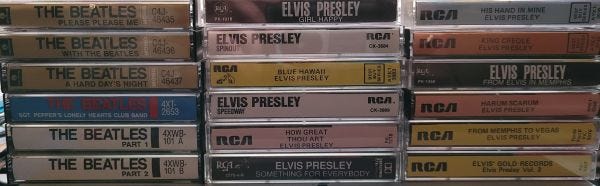
The ease—setting aside the question of legality—of taping off the radio also meant that I could add songs to my collection faster than I could stretch my modest allowance. There was the feeling of being an archivist here.
But, even as tape fueled my love of and curiosity about music, there was something lacking in them. They seemed adolescent. It’s what one bought when you were in the minor leagues of record collecting. Vinyl was for the adults. Kids would just ruin them and indeed, there is a stack of my grandparents’ records that bear the brutality of my attack on them as they gave me free reign of them and of their hi-fi when I was all of six years old.
I think it was some sort of latent guilt over that, though my grandparents never seemed to care let alone mind what I did, so that when I received a Magnavox combination system of a record player on top, dual tape deck at the bottom, a graphic equalizer in the middle and two speakers to connect in the back, I would take care of my records. And I did.
Buying records in the late eighties, just as the death knell was sounded for vinyl (prematurely, of course), meant replacing my cassette collection of Presley and the Beatles with the same albums on vinyl. That seemed right and exciting, and once I received a Panasonic discman a few years later, I did the same thing with CDs.
Tapes were still important. Creating mixtapes. Building compilations out of what I taped off the radio. All of it an effort to try to organize and make coherent my broadening musical tastes, branching out into classic rock, soul, seventies singer-songwriters and jazz—especially jazz. That was the biggest sign that when it came to music, I was determined to be anything but conventional. That also applied to following the NBA instead of the NHL—a Canadian cliché that held no appeal to me—reading Shakespeare before my teens and generally ignoring any and all contemporary music. To paraphrase the Rolling Stones, “baby, baby, I was out of time.”
By the late nineties, the death knell that had rung for vinyl rung as well for cassettes. Building a jazz collection meant buying CDs with the occasional LP. Tapes? Are you kidding me?
And so they sat unloved as my Magnavox system was succeeded by an increasingly sophisticated adult stereo system with an amplifier, turntable, CD changer and four speakers. Along the way, I added a tape deck, a Sansui, which came in super handy for continuing to make mixtapes but, by the turn of the millennium, that began to feel too time consuming. I also recall the dismay when one of my carefully assembled tapes was chewed up by my Walkman.
CDs were the focus for about a decade and then by 2009, as the vinyl revival began to rumble, I began to build an LP collection full of rock, soul, country, Sinatra and other pop stylists, and eventually classical too. Tapes? What are those?
As a lark, I bought the cassette version of the 2022 release of Creedence Clearwater Revival’s concert at Royal Albert Hall from April 1970. A few months later, my wife got me a tape copy of Leonard Bernstein’s Greatest Hits from recordings on RCA Red Seal. That was another fun novelty.
And then there’s a few weeks ago. I went to my thrift shop on a Friday afternoon in need of some retail therapy on a budget. The shop is hit and miss when it comes to albums. Sometimes, there are wonderful stacks of country and classical records. Other times, there’s nothing. This visit was an example of the former. A sealed Joe South album, So the Seeds Are Growing and one sealed by the Hollyridge Strings, Hits of the 70’s (something I need some easy listening). Artur Rubenstein playing Beethoven, Murray McLauchlan's Sweepin’ the Spotlight Away and Billy Graham stalwart George Beverly Shea (it’s Lent, after all).
Next to the records were a small collection of tapes. The Byrds’ Greatest Hits, first released in 1967, caught my eye. Now, I’ve had all five of their albums from the David Crosby era for years so this collection is completely redundant. But after much hemming and hawing, I left the store with it, got home and fired up the old Sansui to give it a listen. Ahhh, that warm, punchy analog sound that only a tape can deliver as Roger McGuinn, Gene Clark and Crosby wordlessly soared at the end of ‘The Bells of Rhymney’ and McGuinn weaved Coltrane-like on his twelve string on ‘Eight Miles High.’
These are recordings I already knew well but as I usually find, hearing overly familiar music in a new context is the closest one can get to hearing it again for the first time. The experience created an itch so off I trundled to the thrift store the next day to see if I could get more tapes. There weren’t many but I did snag copies of Roy Orbison’s Mystery Girl, the too-soon conclusion to his late-eighties resurgence and Barbra Streisand’s The Third Album, an artefact of her rise pre-Funny Girl.
I then perused Amazon to see if there were any tapes there for sale. Cassette sales are growing although they are only a fraction of vinyl sales. Still, I found a few options and the next day, McCartney III arrived as well as a long-unopened copy of an RCA compilation of recordings on the label from the sixties called Nipper’s Greatest Hits - The 60s, Volume 1. Next up was to head to our laundry room and clear the debris to dig out the box of most of my old cassettes (the remainder are somewhere at my parents).
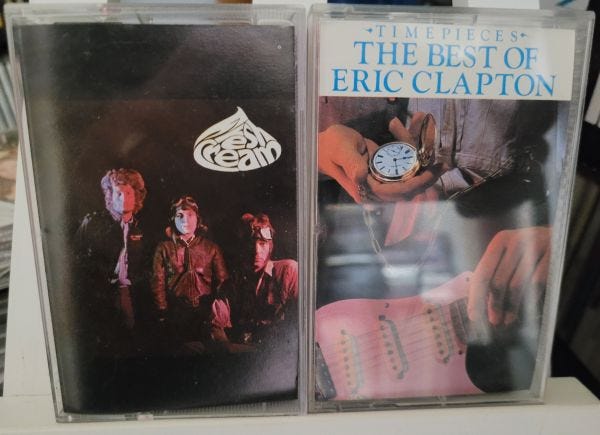
I picked out a few albums I never replaced on CD or LP like Cream’s Fresh Cream and Eric Clapton’s Timepieces: The Best of Eric Clapton. I listened to both a lot in the early nineties when my obsession with Slowhand was at its height and I spent the hours needed to master his guitar parts on ‘Cocaine,’ ‘Badge,’ ‘White Room,’ ‘Lay Down Sally’ and other classics. Disagree with Clapton’s politics or his swerving into soft rock but “Clapton is God” was spray painted on London walls for a reason. Hear the stinging of his solo lines on ‘I’m So Glad,’ ‘N.S.U.’ or ‘Cat’s Squirrel’—three of the high points from Fresh Cream. They still cut with the unmistakable blade of burgeoning genius. I revisited both albums with pleasure.
I also digged out Collectors Gold, a three-volume collection of Presley’s from the RCA archives that was released in 1991. Now, every last outtake he recorded that wasn’t destroyed or recorded over has been released (most of it more than once) but back then, very few had. In fact, Collectors Gold was the first significant tranche of outtakes from the sixties with one volume dedicated to his recordings in Nashville and another to his soundtrack sessions. The other volume included selections from his return to live performances in the summer of 1969 in Las Vegas.
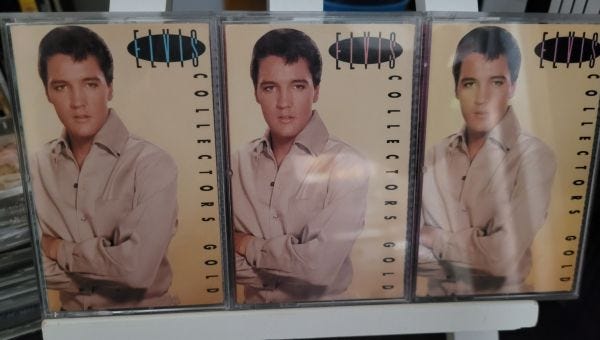
As someone who has always felt that Presley was at his peak in the sixties, Collectors Gold was an exciting release and as I went through each volume once again, I recalled all the moments of studio back-and-forth, including a wild sequence from the recording of ‘Goin’ Home,’ consigned to a bonus track on the Speedway soundtrack, in which Presley ruins a take by launching into ‘Heartbreak Hotel.’
As I get older, my ability to remember things ain’t what it used to be, including music. Back when I was buying tapes, everything seemed to stick, both in the head and in the heart. It’s been good to be reminded of these halcyon days. Here’s to the humble cassette.
I wore out my "Workingman's Dead" tape playing it in my camper van driving around the country. That's where tapes sounded best to me, with wind blowing through the open window and the sound of a straight six engine at my right elbow. (The van was a '68 Dodge, with the engine in a box between the seats.)
What a fine love letter. Thanks for this. I've been sitting on one of these odes to the cassette for a while now, and this inspired me to dust it off and work it up. So many memories and adventures!